


Migrating ADT notifications to FHIR without ripping out the rails the industry runs on
Admit, discharge, and transfer (ADT) events do a lot of unglamorous work in U.S. care coordination. When a patient arrives in an emergency department, an HL7 v2 ADT message usually reaches a care manager, a health plan, or a regional exchange within minutes. These feeds have carried event notifications for decades, and they work.
That reliability is what makes them so hard to replace. FHIR is where interoperability is heading: topic-based subscriptions, standardized attribution, more computable payloads, and APIs that payers and providers can both build on. But no health system, payer, or HIE is going to shut off thousands of production HL7 v2 and IHE interfaces on a Friday and turn on FHIR the following Monday. Nobody can afford a “rip and replace” cutover. The industry has largely settled whether to move to FHIR. The open question is how to get there while the existing rails keep running.
Why start with ADT
ADT is infrastructure. Nearly every organization in the care continuum produces or consumes it, it is event-driven by nature (the model FHIR Subscriptions was built for), and it crosses the payer-provider boundary every day. A migration path proven on ADT gives the industry a pattern it can reuse for most other exchanges.
Providers, payers, health IT developers, and federal stakeholders keep asking for the same improvements:
- Richer content. Notifications that carry more clinical and administrative context than a v2 segment can comfortably hold.
- Consistency. Fewer one-off, partner-specific versions of what is supposed to be the same feed.
- Broader access. Notifications for payers, ACOs, and care-coordination organizations that sit outside the traditional feed.
- Better attribution. Roster and attribution exchange based on standards such as the Da Vinci Member Attribution (ATR) IG, instead of spreadsheets.
The standards behind these needs are maturing quickly: FHIR Subscriptions and its R4 Backport, the Da Vinci Unsolicited Notifications IG, Da Vinci ATR, and federal efforts such as ONC’s LEAP project on FHIR Subscriptions. The specifications exist. What’s missing is a proven way to adopt them alongside the systems already in production.
Conformant messages do not guarantee interoperability
A notification is a lifecycle rather than a single message. A clinical event occurs; a message is generated, transformed, and routed; attribution identifies the right recipient; the notification is delivered; and someone acts on it. A failure at any of those handoffs breaks the exchange, even when every message along the way is valid.
We run into this often. A well-formed message goes to the wrong organization because the attribution data was stale. The right recipient has no discoverable endpoint. A routing decision that is technically valid conflicts with how the receiving organization actually works. Migration makes all of this harder, because each clinical event now exists in two forms, HL7 v2 and FHIR, and both have to mean the same thing.
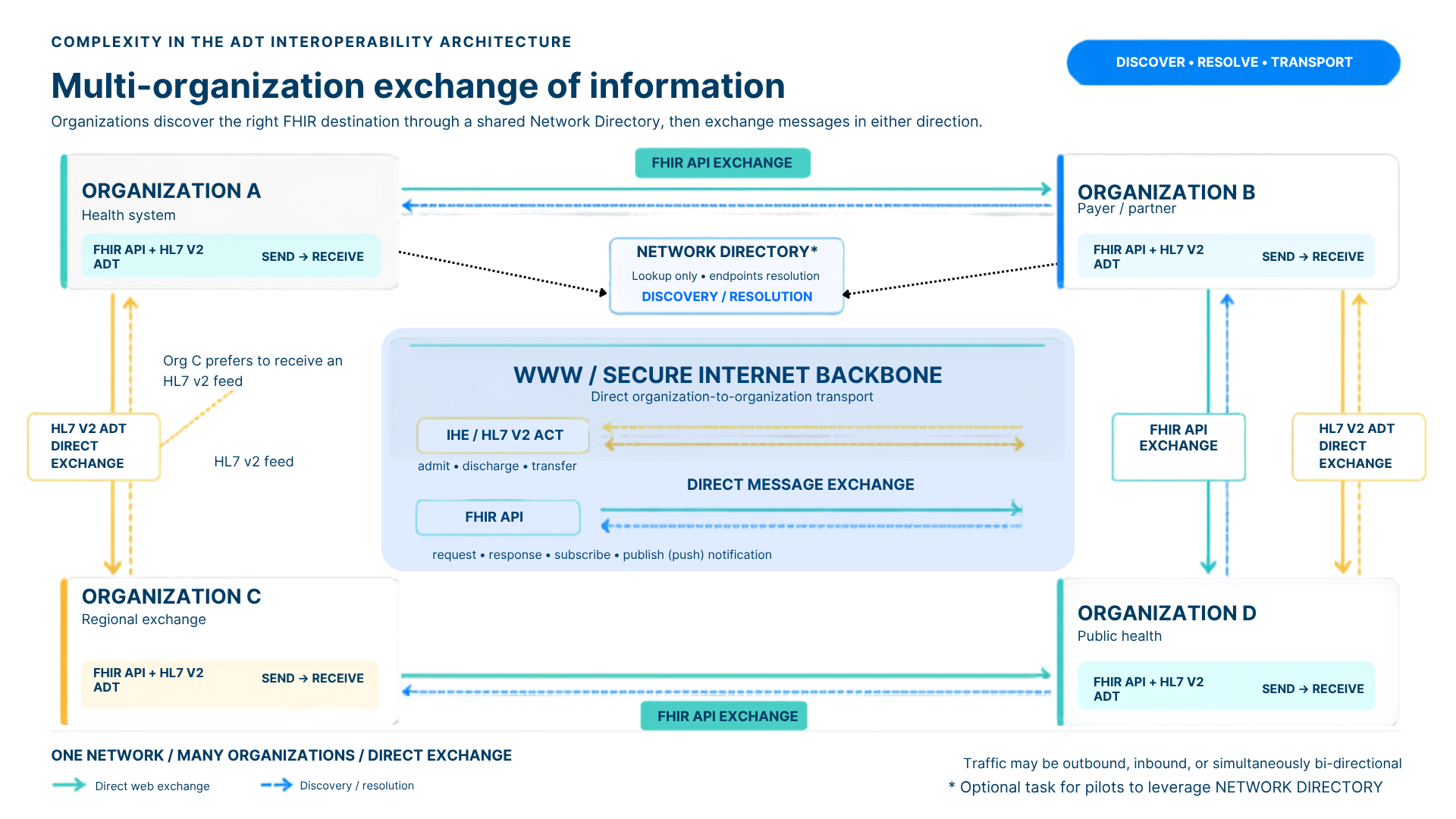
Figure 1. Discover, resolve, transport: one network, many organizations, both rails. Organization C still prefers an HL7 v2 feed, and any migration has to accommodate partners like it.
Figure 1 shows a realistic environment. A health system, a payer, a regional exchange, and a public health agency each send and receive over both FHIR and HL7 v2. A shared Network Directory handles lookup only (discovery and endpoint resolution), and the organizations exchange data directly over the secure internet backbone, in either direction. Some partners are ready for FHIR now; others will run v2 for years. A workable migration plan has to serve both groups at once.
The AEGIS Dual-Rail Architecture
AEGIS designs around one principle: the same data, across different interfaces, now and in the future. Whether a partner receives an A03 discharge as an HL7 v2 message or as the equivalent FHIR notification, both must carry the same complete clinical meaning. The Dual-Rail Architecture applies that principle through four elements:
1. The legacy rail keeps running
Existing HL7 v2 ADT exchange (A01, A02, A03, A04, A08, A28/A31 and related events), along with IHE profiles such as ITI-31 Patient Encounter Management and PIX/PDQ for identity, continues without interruption. Coexistence comes first. Destabilizing a mechanism the industry depends on is the quickest way to lose stakeholders’ trust.
2. Per-event FHIR eligibility
ADT rarely travels straight from the EHR to the recipient. It usually passes through an integration or interface-engine layer, and that is where Dual-Rail operates. For each event, the layer determines whether the notification could also go out over a FHIR path, such as a Subscriptions topic or the Da Vinci Unsolicited Notifications IG, without affecting any existing v2 consumer.
3. Directory and attribution as routing infrastructure
Correct routing depends on knowing who is responsible for the patient and where they want to receive the event. Dual-Rail treats two services as core infrastructure: an endpoint directory that records each recipient’s supported and preferred channels, and member attribution informed by Da Vinci ATR.
4. Cross-standard equivalence, proven by test
Paired synthetic examples of the same ADT events, rendered in both HL7 v2 and FHIR, show implementers exactly how each event is expressed on each rail and give them a reference to test against. The pairs also surface gaps, such as a v2 concept with no clean FHIR equivalent or an IG requirement with no place for a v2-origin data element. We report each gap back to the standards community.
Moving in stages. Dual-Rail advances each partner and each flow only when the evidence supports it:
| Stage | What happens | Evidence to advance |
|---|---|---|
| 1. Coexist | v2/IHE flows continue untouched; FHIR capability is stood up alongside. | No regression on existing feeds; baseline conformance measured. |
| 2. Recognize | Each event is evaluated for FHIR eligibility using directory and attribution data. | Eligibility decisions verified against partner capabilities and preferences. |
| 3. Route | Selected flows are delivered via FHIR under controlled conditions. | End-to-end workflow tests pass; semantic equivalence confirmed against the v2 rail. |
| 4. Expand and retire | More partners and flows move over; v2 interfaces are retired only where partners are verified ready. | Sustained conformance and operational results across partners. |
Proving it works: test-first migration
Every step in a migration needs a way to check it. AEGIS brings a test-first discipline that has shaped how the FHIR community verifies conformance for more than a decade:
- Requirements as executable tests. AEGIS co-authored the HL7 FHIR TestScript specification. Each requirement becomes a test that passes or fails, which leaves no room to argue about what counts as correct.
- Reference implementations that behave like production systems. AEGIS introduced the Level 1/2/3 Reference Implementation maturity model in the FAST Accelerator. Validating a full ADT lifecycle across multiple IGs takes a Level 3 RI that implements both the request and response sides; a mock API won’t do it.
- Version awareness. Most of the industry runs R4 today and handles Subscriptions through the R4 Backport. Organizations will move to R5 and R6 on their own schedules, so tests and RIs have to check compatibility in both directions.
- Evidence that testing improves conformance. A peer-reviewed 2018 study in JMIR Medical Informatics found a strong correlation (R² = .883) between regular use of the Touchstone testing platform and FHIR server conformance.
Test-first also changes how the community learns. Instead of showing up at a Connectathon hoping to find problems, implementers build against published tests, check themselves along the way, and arrive with measured conformance. Events shift from demonstration to verification. Over time, the implementation community takes the lead through educational sessions, hack-a-thons, project-a-thons, and implementation-a-thons that feed into HL7 and IHE Connectathons.
Building the business case for migration
Executives fund outcomes, so the case for standards work has to be made in those terms. A credible business case for moving ADT to FHIR should admit that running two rails costs more for a while, then show when and why those costs come down. AEGIS helps organizations build that case around five questions:
| Question | What to measure |
|---|---|
| What does today cost? | Number of point-to-point ADT interfaces, custom mappings per partner, time to onboard a new partner, ongoing maintenance effort, and manual roster and attribution work. |
| Where is the value? | Faster directory-driven onboarding, richer notification content, broader payer and ACO access, fewer misrouted or late notifications, and alignment with CMS interoperability rules and TEFCA. |
| What does the transition cost? | Mapping, testing, staff time, and the period of dual operation, all stated up front. |
| What risk does Dual-Rail avoid? | Outages from big-bang cutovers, conformance defects discovered too late, and dependence on partner-specific custom integrations. |
| When do we move the next flow? | Explicit decision gates tied to conformance results and partner readiness, so evidence justifies each step. |
The case should rest on measured results rather than assumptions. Conformance and end-to-end test results give leadership the numbers it needs to decide when to invest, when to advance, and when a legacy interface can be retired.
What needs to happen
No single organization can move ADT to FHIR on its own. We see seven steps for the industry:
- Inventory the installed base by event type, segment, IHE profile transaction, and partner.
- Agree on equivalence. Publish paired v2/FHIR examples and mappings so everyone tests against a shared definition of equivalence.
- Stand up directory and attribution services as shared routing infrastructure.
- Test first, and keep testing using executable conformance tests and higher-maturity reference implementations.
- Migrate incrementally, flow by flow and partner by partner, behind evidence-based gates.
- Close the loop with standards bodies. Report gaps through HL7 Work Groups, the Da Vinci and FAST Accelerators, and IHE, and track them to resolution.
- Build a community that can adopt on its own, so each additional organization can join at much lower cost.
Introducing the AEGIS Dual-Rail Migration Initiative
AEGIS is launching an initiative to help organizations run legacy and FHIR exchange side by side and build the business case for moving from one to the other. We will work with participants on:
- Education tailored for technical, business, and policy audiences.
- Dual-Rail readiness assessments that map your ADT installed base, partners, and candidate flows.
- Business case workshops built around current-state costs, value levers, and decision gates.
- Test-first enablement using open FHIR TestScripts, Level 3 reference implementations, and the Touchstone platform.
- Community events that prepare implementers for HL7 and IHE Connectathons and send real-world findings back to the standards bodies.
Why AEGIS. AEGIS has worked across HL7 v2, IHE, NHIN, and FHIR for more than 15 years. We co-authored FHIR TestScript, introduced the RI maturity model used across the FAST Accelerator, contribute to the FHIR IG Publisher, have led FHIR Connectathon testing tracks, and are an HL7 education partner whose work underpins FHIR certification materials. We have delivered production test tooling and implementer office hours for CMS-0057-F and the FAST Security (UDAP) and Consent IGs, and HL7 International featured our approach in its 2024 “Setting the World on FHIR” case study. We work on both rails every day, including the boundary between them.
Work with us
If you are a health system, payer, HIE or QHIN, public health agency, or health IT vendor trying to modernize ADT and notifications without disrupting what works today, we’d like to hear from you, whether you want to join the initiative, assess your readiness, or build a migration business case.
Mario G. Hyland, Founder & SVP, AEGIS.net, Inc.
mario.hyland@aegis.net · (703) 893-6020 ext. 707 · aegis.net · linkedin.com/in/interopguy
References
- Walonoski J, et al. Validation and Testing of Fast Healthcare Interoperability Resources Standards Compliance: Data Analysis. JMIR Med Inform 2018;6(4):e10870. medinform.jmir.org/2018/4/e10870
- HL7 International. Setting the World on FHIR: AEGIS.net, Inc. Case Study (2024). hl7.org case study
- HL7 Da Vinci Member Attribution (ATR) List IG. build.fhir.org/ig/HL7/davinci-atr
- ONC 2025 LEAP Health IT Projects: FHIR Subscriptions. healthit.gov